


Asset Sale vs. Share Sale: Which Is Right for Your Business in Nepal?
Introduction
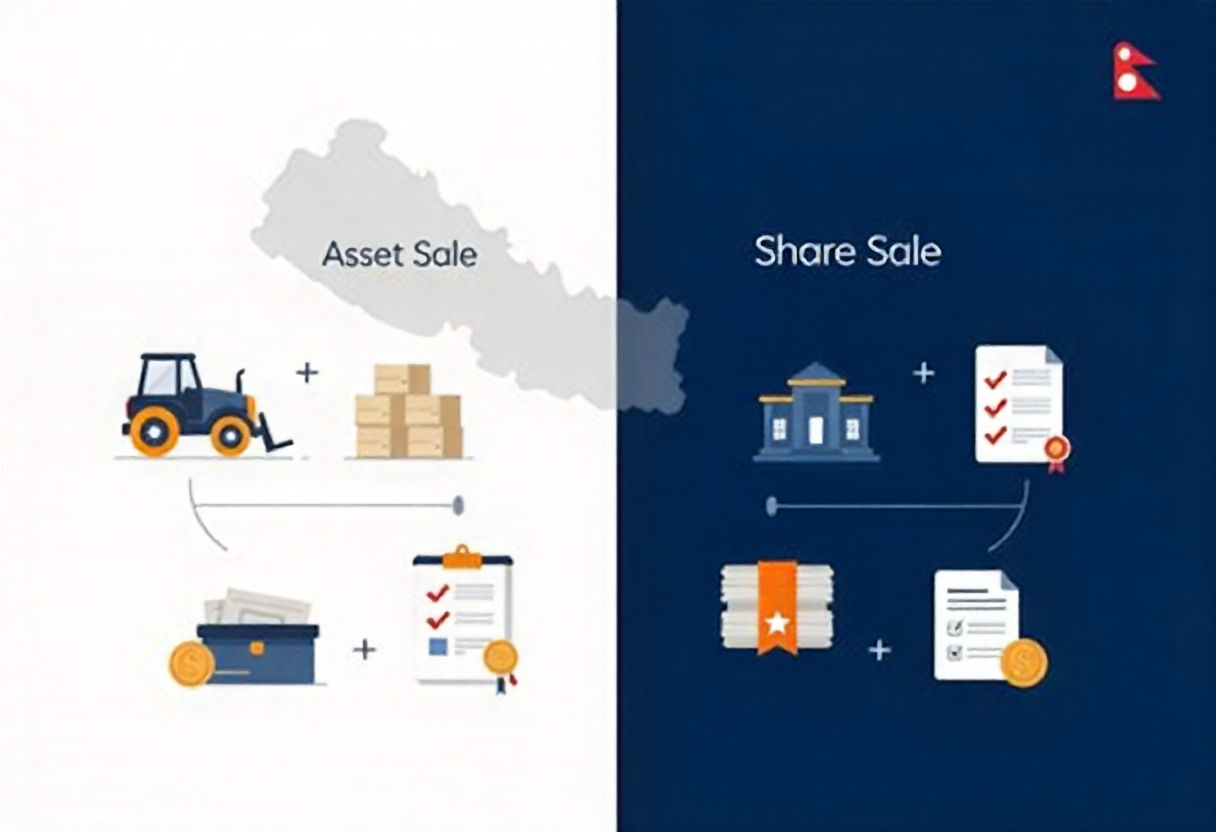
- An asset sale transfers selected assets and specified liabilities from the seller to the buyer; the buyer does not acquire the legal corporate vehicle.
- A share sale (stock sale) transfers ownership of the company (shares), so the buyer steps into the seller’s shoes — contracts, licenses and liabilities remain with the company.
- Tax, regulatory approvals, third-party consents, and commercial warranties differ dramatically between the two: asset sales allow buyers to “pick and choose” but require transfer formalities for each asset; share sales are cleaner commercially but import hidden liabilities and may trigger regulatory approvals (including FDI rules and approvals).
Why structure matters — legal and commercial overview
What changes hands
- Asset sale: specific assets (machinery, intellectual property, goodwill, receivables, inventory, customer contracts if assignable) and only the liabilities you expressly assume. This gives buyers control over risk allocation.
- Share sale: buyer purchases shares; the company continues with the same legal identity, owning assets and liabilities. Buyer acquires contingent liabilities, historic tax exposure and employment obligations unless contractually addressed.
Nepal-specific legal anchors
- The Companies Act, 2063 (2006) governs company formation, share transfers and corporate procedures in Nepal and sets statutory formalities for share transfers and requisite filings. For share sales, compliance with share transfer procedures, stamp duty, board resolutions and Registrar filings is essential.
- Income Tax Act and rules regulate tax consequences for disposal of assets and shares — capital gains, VAT and withholding rules may apply differently depending on whether the transaction is an asset sale or a share sale.
Comparative Analysis: Asset Sale vs. Share Sale
| Aspect | Asset Sale | Share Sale |
|---|---|---|
| Ownership Transfer | Specific assets and liabilities | Entire company, including all assets and liabilities |
| Liabilities | Potentially limited to selected liabilities | All existing liabilities assumed |
| Tax Implications | Varies based on asset type and holding period | Capital gains tax applicable on share sale profits |
| Complexity | Requires detailed asset allocation and valuation | Generally simpler transaction process |
| Continuity | May require new entity formation | Business continuity maintained |
Tax consequences — critical in deal economics
Asset sale: common tax issues
- VAT (where applicable): Sale of goods/inventory and certain services may attract VAT under Nepalese law; transferring fixed assets may be VAT-exempt depending on the nature of assets and seller’s VAT registration.
- Capital gains/business income: Sellers may be taxed on gains from asset disposals; buyers may obtain fresh tax bases for depreciable assets (useful for future depreciation/tax amortisation).
Share sale: common tax issues
- Capital gains on shares: Sale of shares is usually subject to capital gains tax; the rate and treatment depend on holding period and classification under Nepal’s Income Tax Act. Sellers often prefer share sales if capital gains treatment is favourable.
- Transfer pricing & stamp duty: Stamp duty and other transfer taxes (e.g., stamp on share transfer deed) apply. In Nepal, stamp duty is typically a percentage on transfer value — ensure compliance to avoid post-closing challenges.
Practical consequence: buyers may favour asset sales for a “clean slate” tax basis; sellers may favour share sales to obtain capital gains and exit the corporate liability chain. Work tax numbers early in negotiation — the economics often determine structure.
Liability and risk allocation
Buyers
- In an asset sale, the Buyer can avoid unknown liabilities (historic claims, long-tail environmental, tax exposures) unless explicitly assumed. However, certain liabilities may transfer by operation of law (employee claims, statutory payments) or require consent to assign (key contracts, licenses).
- In a share sale, the Buyer inherits existing liabilities (contractual, tax, litigation) and must perform deeper due diligence to quantify contingent exposures. This typically increases required representations, indemnities and purchase price adjustments.
Sellers
- In asset sale: Seller may retain corporate shell with residual liabilities and workers; requires further wind-down procedures or re-use of entity. Also, sellers must ensure transferability of assets (e.g., landlord consent for lease assignments).
- In a share sale, the Seller exits fully but may need to give seller warranties and indemnities to secure buyer comfort. Seller’s historical conduct becomes critical.
Due diligence: how it differs and what to plan for
Asset sale due diligence (targeted)
- Focused on the assets being acquired: title to property, IP ownership, leased asset transferability, inventory quality, tax records for those assets, security interests and third-party consents. Due diligence is often narrower and faster.
Share sale due diligence (holistic)
- Company-wide: contracts, litigation, employee issues, tax audits, environmental compliance, corporate records, contingent liabilities, related-party transactions, and historic warranties. Share sales require more intrusive diligence and frequently longer timelines.
Practical advice: set diligence scope in the LOI; for share sale, expect escrow, reps & warranties insurance or enhanced indemnities.
Regulatory approvals & third-party consents in Nepal
Share transfer approvals
- Share transfers often need board approval, proper execution of the share transfer deed, payment of stamp duty, and registration with the Office of the Company Registrar. Public companies or companies with pre-emptive rights in their articles require additional compliance.
FDI-specific controls
- For foreign buyers, FDI approvals may be required (Department of Industry / Investment Board Nepal / Nepal Rastra Bank), and repatriation rules must be considered. Transactions that change foreign shareholding percentages may trigger separate filings and approvals under the Foreign Investment and Technology Transfer Act and NRB bylaws. Ensure early contact with regulators.
Asset transfers requiring consents
- Asset assignments (e.g., technology licenses, land, leases, government permits) frequently require third-party or governmental consents. Failure to obtain them can nullify the transfer or expose parties to litigation.
Contract architecture: typical documents for each route
Asset sale docs
- Asset Purchase Agreement (APA) — key schedules (assets, assumed liabilities, excluded assets).
- Bill of sale/transfer deeds for specific asset classes, IP assignment, and inventory schedules.
- Employment transfer/termination letters or collective agreements for staff transfers (if required).
- Consents from landlords, licensors, and regulatory authorities.
Share sale docs
- Share Purchase Agreement (SPA) — price mechanics, escrow, completion accounts, closing conditions.
- Share transfer deed and board minutes authorising transfer.
- Shareholders’ agreements/amendments to reflect new ownership.
- Warranties, indemnities, escrow and completion adjustments (customary).
Negotiation levers: what buyers and sellers haggle over
- Price vs protections: Buyers pay a higher price for share sale convenience but demand larger warranties/escrows; sellers prefer share sale to exit cleanly.
- Scope of assumed liabilities: Buyers want narrow assumptions in asset sale; sellers may resist leaving significant contingent liabilities behind.
- Tax gross-ups and indemnities: Sellers may require buyers to handle VAT or tax on asset transfer; buyers may seek price reductions for expected tax liabilities.
- Employee liabilities and retention: Whether employees move under the buyer or are terminated affects cost and continuity.
- Regulatory clearances timeline: Delays to approvals (FDI, NRB) can trigger price adjustments or break fees.
Practical checklists (deal-stage specific)
Pre-LOI (seller and buyer)
- Map assets, contracts, licences, permits, and which of those are assignable.
- Run a high-level tax analysis for asset sale vs share sale (IRR impact).
- Identify any foreign investment triggers and pre-approvals required.
Before signing the APA or SPA
- For asset sale: prepare schedules for each asset class, list assumed liabilities, and obtain landlord/licensor pre-consents where possible.
- For share sale: prepare corporate records, audited accounts, tax clearances, list of ongoing litigation and contingent liabilities.
- Agree on escrow mechanics, reps & warranties, and indemnity caps.
Closing & post-closing
- File required share transfer forms with the Company Registrar; pay stamp duty.
- Transfer titles, update IP registry, register assignment of contracts and notify customers/suppliers as agreed.
- Tax filings and necessary notifications to NRB (for FDI) and the Inland Revenue Department.
Examples and typical scenarios
- Buyer wants to exclude historic liabilities: choose asset sale — buyer acquires only the clean assets.
- Seller needs a clean exit and avoids management of residual liabilities: choose share sale — seller transfers entire company.
- Foreign buyer entering restricted sectors: sometimes a share sale is used to import FDI while respecting sectoral limits, but regulatory approvals must be cleared.
Negotiation drafting tips (clause-by-clause highlights)
- Warranties & representations: in share sales, include reps about solvency, tax filings, no undisclosed liabilities, and IP ownership. In asset sales, include asset title and condition reps.
- Indemnities: cap, basket (threshold), survival period, and carve-outs for fundamental breaches.
- Completion accounts vs locked-box: choose a suite based on tax and accounting preferences — locked-box transfers price certainty; completion accounts adjust price post-close.
- Escrow mechanics: protect against warranty claims and tax tail risk.
- Break / reverse break fees: for sponsor-backed deals or where regulatory approvals risk failure.
Case law / regulatory citations (Nepal context)
- Companies Act, 2063 — governs share transfers, board procedures and registry formalities.
- Income Tax Act and accompanying rules — control capital gains and tax treatment of asset and share disposals.
- Nepal Rastra Bank (NRB) bylaws and FDI regulations — relevant where foreign investors repatriate proceeds or buy shares of Nepalese companies.
(Note: always confirm the most recent amendments and circulars with NRB and the Inland Revenue Department before closing.)
When to prefer an asset sale
- Buyer controls over assumed liabilities.
- Easier to negotiate price allocation for tax benefits.
- Simpler for business lines with many non-transferable contracts (buyer wants only specific assets).
- Seller is willing to retain the corporate shell or wind up the remaining entity.
When to prefer a share sale?
- Straightforward transfer of business ownership (no need to re-assign every contract).
- Seller prefers capital gains treatment and full exit.
- Sectoral or regulatory constraints make asset transfers onerous or expensive.
- Buyer is comfortable with residual risks and relies on stronger warranties/indemnities.
FAQs
Q1: Which is cheaper — asset sale or share sale — in Nepal?
A: There is no universal answer. Asset sales may be costlier in transactional fees because each asset requires transfer documentation, VAT and stamp duties may apply, and third-party consents increase costs. Share sales concentrate costs on stamp duty and share transfer formalities, but may attract lower transaction tax for sellers depending on capital gains provisions. Run deal-specific tax modelling early.
Q2: Can foreign investors buy shares in any Nepalese company?
A: Not necessarily. Sectoral restrictions exist; foreign investors require approvals from the DOI/IBN and Nepal Rastra Bank for repatriation. Check the Foreign Investment and Technology Transfer Act and sectoral lists early.
Q3: Do I need landlord consent to buy a business via asset sale?
A: Typically yes, if the business operates from leased premises and the lease contains anti-assignment clauses. Without landlord consent, the lease may not be assignable, risking loss of premises.
Q4: How long does share transfer registration take in Nepal?
A: It varies; off-market/private transfers require documentation, board approval, stamp duty payment, and Registrar filing — often days to weeks depending on complexity and whether NEPSE is involved for listed securities.
Q5: How should sellers manage retained liabilities after an asset sale?
A: Sellers should disclose all known liabilities, procure indemnities, set aside escrow or insurance to manage residual risks, and plan the corporate wind-down or repurposing of the shell. Legal and tax closure steps must be followed to avoid post-closing exposure.
Practical sample checklist
- Initial structuring memo: run tax modelling and regulatory mapping (FDI, sector restrictions).
- Scope assets or shares: prepare asset schedules or share certificates and corporate pack.
- LOI / Term Sheet: set conditionality, exclusivity, price basis and timeline.
- Diligence: targeted for assets; full for share sale.
- Draft APA/SPA: include reps, indemnities, escrow, and completion mechanics.
- Consents & filings: landlord, licensor, Registrar, NRB/DOI (if applicable).
- Closing: transfer titles, file Registrar forms, pay stamp duty, and make payments.
- Post-closing integration / wind-down: transfer employees, update registers, and tax filings.
Sample clause checklist
- Definition of “Assumed Liabilities” (asset sale) — precise list and examples of excluded liabilities.
- Tax indemnity clause — allocation of pre-closing taxes and gross-up wording.
- Employee transition clause — who pays severance/retention.
- Escrow and claim procedures — claim notice, dispute resolution, survival periods.
- Completion conditions — regulatory approvals and absence of material adverse change (MAC) triggers.
Recommended next steps (for both buyers and sellers)
- Run early tax and regulatory scoping — get IRD and NRB checklists in parallel.
- Choose a structure that aligns commercial objectives (buyer risk appetite vs seller exit need).
- Engage counsel early to draft a conditional LOI and manage consents.
- Consider reps & warranties insurance for share sale if seller refuses large escrows, but buyer needs protection.